AI Agents vs AI Chatbots: What’s the Difference? The Complete 2026 Guide
AI Agents vs AI Chatbots: What’s the Difference?
Artificial Intelligence (AI) is transforming the way businesses operate, automate tasks, and interact with customers. For years, AI chatbots have been the go-to solution for customer support and virtual assistance. However, a new generation of AI technology has emerged—AI agents.
Many people use the terms AI chatbot and AI agent interchangeably, but they are fundamentally different. While chatbots are designed to answer questions and hold conversations, AI agents can reason, make decisions, use external tools, and complete complex tasks with minimal human intervention.
In this comprehensive guide, you’ll learn the key differences between AI agents and AI chatbots, how each technology works, their business applications, advantages, limitations, and which solution is best for your organization.
What Are AI Agents?
An AI chatbot is a software application that interacts with users through text or voice. Traditional chatbots follow predefined rules, while modern AI chatbots use Large Language Models (LLMs) to generate human-like responses.
AI chatbots primarily focus on communication. They answer questions, provide recommendations, assist customers, and automate routine conversations.
Common examples include:
- Customer support bots
- Website assistants
- Banking chatbots
- Healthcare appointment assistants
- Educational virtual tutors
Although modern chatbots are highly intelligent, they usually require users to guide every step of the conversation.
What Is an AI Agent?
An AI agent is an intelligent autonomous system capable of understanding goals, planning actions, making decisions, using external tools, and completing multi-step workflows independently.
Unlike chatbots that simply respond to prompts, AI agents actively work toward achieving a specific objective.
For example, instead of merely answering how to book a meeting, an AI agent can:
- Check your calendar
- Find available time slots
- Send invitations
- Reserve a meeting room
- Notify participants
- Update your CRM
All these actions can happen automatically with minimal human involvement.
This ability makes AI agents significantly more powerful than traditional AI chatbots.
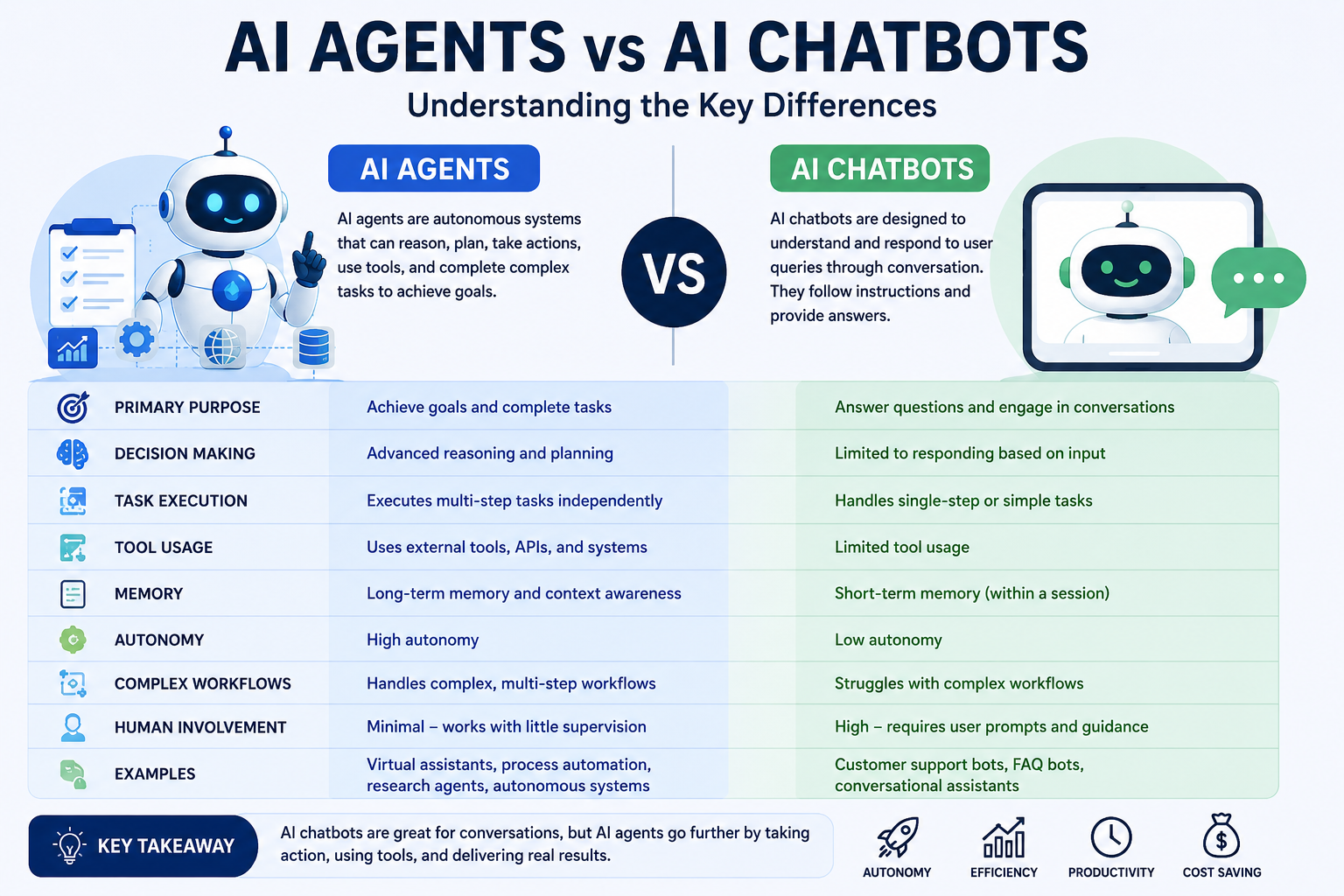
AI Agents vs AI Chatbots: Key Differences
| Feature | AI Chatbots | AI Agents |
|---|---|---|
| Primary Purpose | Conversations | Task execution |
| Decision Making | Limited | Advanced |
| Planning | No | Yes |
| Tool Usage | Limited | Extensive |
| Memory | Session-based | Long-term memory |
| Workflow Automation | Basic | Complex |
| Autonomy | Low | High |
| Multi-Step Tasks | Limited | Yes |
| API Integration | Basic | Advanced |
| Business Intelligence | Moderate | High |
The biggest difference is autonomy. AI chatbots respond to requests, while AI agents proactively complete tasks.
How AI Chatbots Work
Modern AI chatbots follow a relatively straightforward workflow:
- Receive user input.
- Understand the prompt.
- Generate a response using an AI model.
- Return the answer.
The conversation ends unless the user provides another prompt.
This makes chatbots excellent for customer interaction but less effective for business process automation.
How AI Agents Work
AI agents use a much more sophisticated architecture.
A typical AI agent workflow includes:
- Understanding the objective
- Planning multiple actions
- Selecting appropriate tools
- Accessing databases or APIs
- Executing tasks
- Evaluating results
- Adjusting the strategy if needed
- Completing the objective
This continuous reasoning process allows AI agents to solve complex business problems.
Key Features of AI Agents
Modern AI agents provide capabilities that traditional chatbots cannot offer.
learn more about :ChatGPT Agent vs Google Gemini: The Ultimate AI Comparison for 2026
Autonomous Decision-Making
AI agents analyze situations and choose the best course of action without requiring constant user instructions.
Long-Term Memory
Agents remember previous interactions, preferences, and business context, enabling personalized assistance.
Tool Integration
AI agents connect with:
- CRM systems
- ERP software
- Email platforms
- Cloud storage
- Databases
- Payment gateways
- Business applications
- APIs
Workflow Automation
Instead of completing one action, agents can execute entire workflows from start to finish.
Business Use Cases for AI Chatbots
AI chatbots remain valuable across many industries.
Popular applications include:
- Customer support
- Frequently asked questions
- Order tracking
- Appointment booking
- Lead generation
- Product recommendations
- Educational assistance
- Banking inquiries
They improve customer experience while reducing support costs.
Business Use Cases for AI Agents
AI agents are reshaping enterprise operations.
Examples include:
Customer Service
AI agents resolve customer issues, create tickets, update CRM records, and initiate refunds automatically.
Human Resources
They screen resumes, schedule interviews, prepare onboarding documents, and answer employee questions.
Finance
AI agents process invoices, reconcile accounts, generate reports, and detect anomalies.
Healthcare
Hospitals use AI agents for appointment scheduling, patient follow-up, medical documentation, and workflow coordination.
Education
Educational institutions use AI agents to personalize learning, automate grading, recommend courses, and monitor student performance.
Sales
AI agents qualify leads, send follow-up emails, update pipelines, and prepare sales reports.
Benefits of AI Agents
Organizations adopting AI agents experience several advantages.
Increased Productivity
Routine tasks are completed automatically, allowing employees to focus on strategic work.
Better Decision-Making
AI agents analyze large datasets and provide actionable insights.
Cost Savings
Automation reduces manual effort and operational expenses.
Faster Response Time
AI agents operate continuously without breaks.
Scalability
Businesses can manage increasing workloads without proportional staffing increases.
Limitations of AI Chatbots
Despite their usefulness, AI chatbots have certain limitations.
- Limited reasoning
- Minimal autonomy
- Dependence on user prompts
- Difficulty handling complex workflows
- Limited access to enterprise systems
These constraints make chatbots less suitable for advanced business automation.
Challenges of AI Agents
Organizations should also understand the challenges associated with AI agents.
Data Privacy
Agents require secure access to sensitive business information.
Governance
Organizations must define clear policies for AI decision-making.
Security
Strong authentication and monitoring are essential.
Implementation Cost
Enterprise AI solutions require investment in infrastructure, integration, and training.
Human Oversight
Critical decisions should still involve human review.
AI Agents vs AI Chatbots: Which Should You Choose?
The right choice depends on your business needs.
Choose an AI chatbot if you need:
- Customer support
- Frequently asked questions
- Website assistance
- Simple conversations
- Lead qualification
Choose an AI agent if you need:
- Business automation
- Multi-step workflows
- Enterprise integration
- Intelligent decision-making
- Autonomous task execution
Many organizations use both technologies together. Chatbots handle conversations, while AI agents execute the underlying business processes.
Future of AI Agents
The future of artificial intelligence is moving toward autonomous systems.
Industry experts predict AI agents will become digital employees capable of managing projects, coordinating departments, analyzing data, writing reports, generating software, and collaborating with humans.
As AI models become more capable, AI agents will play a central role in digital transformation across healthcare, education, finance, manufacturing, retail, and government.
Organizations that adopt AI agents early are likely to gain a competitive advantage through improved efficiency, innovation, and customer experience.
Frequently Asked Questions
What is the main difference between AI agents and AI chatbots?
AI chatbots primarily answer questions and engage in conversations, whereas AI agents can plan, make decisions, use external tools, and complete complex tasks autonomously.
Can AI agents replace AI chatbots?
Not entirely. Chatbots excel at conversational interactions, while AI agents are better suited for workflow automation and decision-making. Many businesses benefit from using both together.
Are AI agents more intelligent than AI chatbots?
AI agents are generally more capable because they combine reasoning, planning, memory, and tool integration to accomplish goals beyond simple conversation.
Which industries benefit most from AI agents?
Healthcare, finance, education, retail, manufacturing, logistics, and customer service are among the sectors seeing significant value from AI agent adoption.
Are AI agents secure?
They can be secure when implemented with strong authentication, role-based access controls, encryption, monitoring, and governance policies. Organizations should also ensure compliance with relevant data protection regulations.
Conclusion
The debate around AI Agents vs AI Chatbots is not about which technology is better—it is about choosing the right solution for the right purpose.
AI chatbots remain an excellent choice for conversational support, customer engagement, and answering routine questions. AI agents, however, represent the next stage of artificial intelligence by autonomously planning, reasoning, integrating with business systems, and completing complex workflows.
As enterprises continue their digital transformation journey, AI agents are poised to become indispensable collaborators that enhance productivity, reduce operational costs, and unlock new opportunities for innovation. Organizations that understand the strengths of both technologies and deploy them strategically will be better positioned to thrive in the AI-driven future.