How AI Is Transforming Small Businesses in 2026 | Benefits, Trends & Future
How AI Is Transforming Small Businesses in 2026
Artificial intelligence (AI) is no longer a tool only for large companies. Today, AI is transforming small businesses in 2026 by making daily work faster, easier, and more affordable. As a result, business owners can save time, reduce costs, and improve customer service. Whether you run a retail shop, restaurant, clinic, or software company, AI can help your business grow and compete in a digital world.
Moreover, modern AI tools are simple to use and require little technical knowledge. Because of this, even startups and small businesses can benefit from AI without spending a large budget.
Why AI Is Transforming Small Businesses in 2026
Small businesses often have limited staff and resources. Therefore, they need smart solutions that improve productivity without increasing costs. AI helps by automating routine work, analyzing business data, and improving customer experiences.
In addition, AI allows business owners to focus on growth instead of spending hours on repetitive tasks. Consequently, teams become more productive and efficient.
AI Is Transforming Small Businesses in 2026 Through Automation
1. Saves Time Through Automation
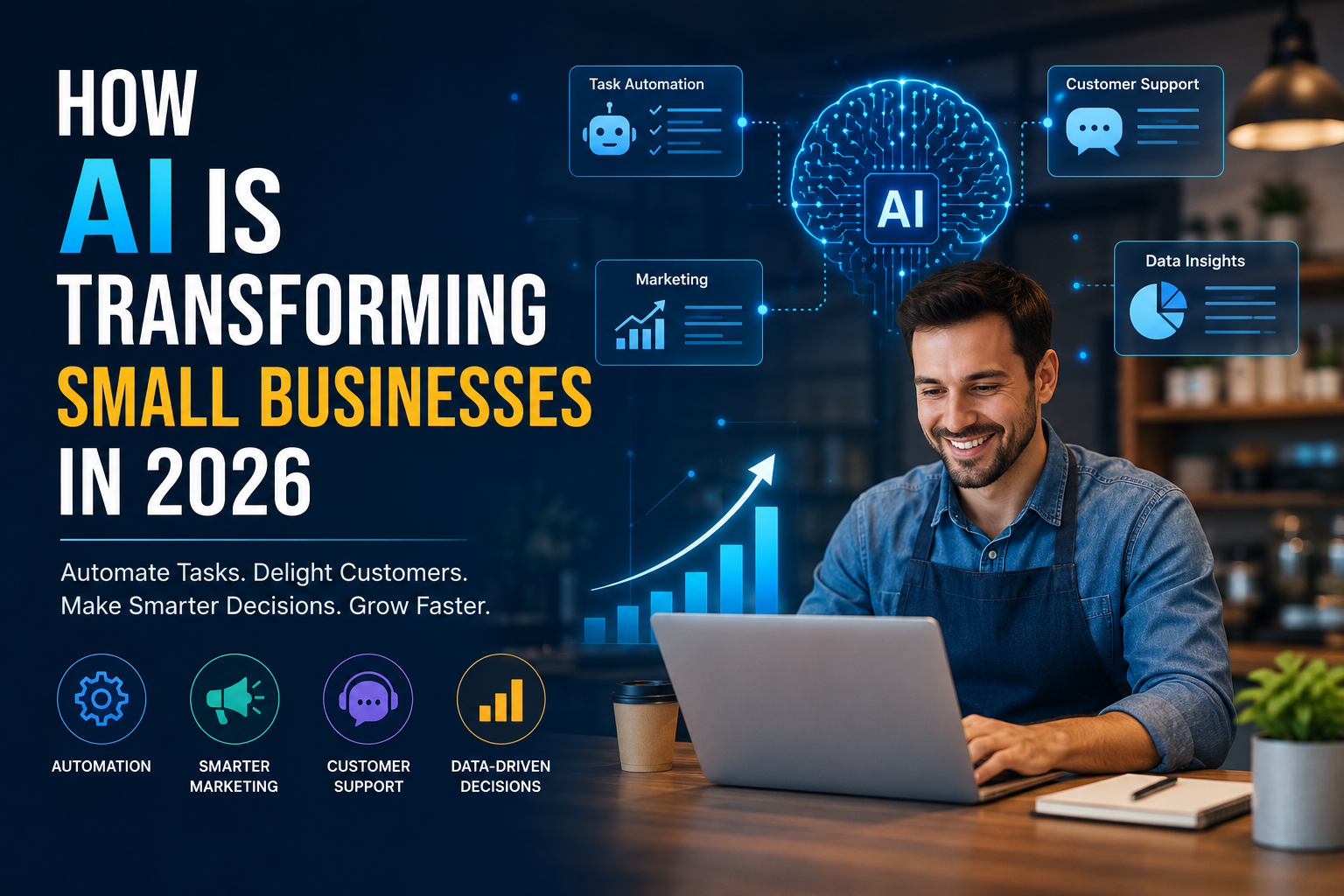
One of the biggest reasons AI is transforming small businesses in 2026 is automation. AI can complete many routine tasks that usually take hours.
For example, businesses can automate:
- Invoice creation
- Appointment scheduling
- Email replies
- Payroll processing
- Inventory tracking
- Data entry
As a result, employees spend more time serving customers and growing the business.
2. Improves Customer Service
Customers expect quick responses. Fortunately, AI-powered chatbots can answer common questions at any time of the day.
For instance, chatbots can:
- Respond instantly
- Track orders
- Book appointments
- Recommend products
- Handle basic support requests
Therefore, businesses provide better customer service while reducing support costs.
3. Makes Marketing More Effective
Marketing becomes much easier with AI. Instead of guessing what customers want, AI studies customer behavior and buying habits.
For example, AI helps businesses create:
- Social media posts
- Blog articles
- Product descriptions
- Email campaigns
- Online advertisements
Furthermore, AI can suggest the best time to publish content and identify the right audience. As a result, marketing campaigns perform better.
4. Supports Better Business Decisions
Good decisions depend on accurate data. However, analyzing large amounts of information takes time.
AI solves this problem by reviewing business data quickly. It can identify trends, predict customer demand, and highlight areas that need improvement.
Consequently, business owners can:
- Forecast sales
- Control expenses
- Improve pricing
- Manage inventory
- Increase profits
AI Across Different Industries
Retail
Retail stores use AI to manage inventory, understand customer preferences, and recommend products. In addition, AI predicts future demand so stores keep the right amount of stock.
Healthcare
Healthcare providers use AI to schedule appointments, organize patient records, and reduce paperwork. As a result, medical staff spend more time caring for patients.
Education
Schools and training centers use AI to create personalized learning experiences. Furthermore, AI helps teachers prepare lessons and assess student progress more efficiently.
Restaurants
Restaurants benefit from AI by improving online ordering, managing inventory, and predicting busy hours. Therefore, they reduce food waste and improve customer satisfaction.
Challenges of Using AI
Although AI offers many advantages, businesses should also understand its challenges.
For example:
- Employees may need training.
- Customer data must remain secure.
- Businesses should choose trusted AI tools.
- Human oversight is still important.
Nevertheless, these challenges are manageable with proper planning and responsible use.
Best Practices for AI Adoption
Businesses should begin with small AI projects instead of changing everything at once.
To get the best results:
- Identify repetitive tasks.
- Choose reliable AI software.
- Train employees.
- Measure performance regularly.
- Improve processes over time.
Meanwhile, businesses should continue reviewing results to ensure AI delivers real value.
The Future of AI
Experts believe AI is transforming small businesses in 2026 and will continue to shape the future. In the coming years, AI agents, predictive analytics, and intelligent automation will become even more common.
Moreover, AI tools will become easier to use and more affordable. Consequently, small businesses will gain access to technology that was once available only to large companies.
Businesses that adopt AI today will be better prepared for tomorrow’s challenges.
Conclusion
There is no doubt that AI is transforming small businesses in 2026. It helps companies automate daily tasks, improve customer service, strengthen marketing, and make smarter decisions.
Furthermore, AI reduces costs while increasing productivity. As technology continues to evolve, more businesses will rely on AI to stay competitive. Therefore, now is the right time for small businesses to explore AI solutions and build a stronger future.
Frequently Asked Questions
What is AI for small businesses?
AI helps small businesses automate routine work, improve customer service, analyze data, and increase productivity.
Is AI expensive for small businesses?
No. Many AI tools offer affordable monthly plans, making them suitable for startups and small businesses.
Which industries benefit most from AI?
Retail, healthcare, education, restaurants, finance, and professional services are among the industries that benefit the most.
Can AI replace employees?
AI is designed to support employees rather than replace them. It handles repetitive tasks so staff can focus on work that requires creativity and human judgment.
What is the biggest benefit of AI?
The biggest benefit is improved efficiency. AI saves time, reduces costs, and helps businesses make better decisions based on data.