
The Future of AI in Business: 10 Ways Artificial Intelligence is Transforming Companies in 2026
Artificial Intelligence (AI) is no longer a futuristic concept—it is a powerful business tool transforming organizations across every industry. From automating repetitive tasks to improving customer service, enhancing decision-making, and increasing operational efficiency, AI is helping businesses become more competitive than ever before.
Whether you’re a startup, a small business, or a large enterprise, AI offers opportunities to reduce costs, improve productivity, and create better customer experiences.
In this comprehensive guide, we’ll explore how AI is transforming businesses, the benefits of adopting AI, common challenges, and what the future holds for AI-driven organizations.
What is AI in Business?
AI in Business refers to the use of artificial intelligence technologies such as machine learning, natural language processing, computer vision, and predictive analytics to automate business processes, analyze data, and support better decision-making.
Businesses use AI to:
- Automate repetitive work
- Improve customer support
- Analyze large datasets
- Forecast sales
- Detect fraud
- Optimize marketing campaigns
- Improve supply chain management
- Personalize customer experiences
Why Businesses are Investing in AI
Organizations are increasingly investing in AI because it helps them:
- Reduce operational costs
- Improve efficiency
- Increase productivity
- Enhance customer satisfaction
- Make faster decisions
- Identify business opportunities
- Improve profitability
According to industry research, companies adopting AI are seeing measurable improvements in productivity and operational efficiency, making AI one of the most important technologies driving digital transformation.
10 Ways AI is Transforming Business
1. Intelligent Customer Support
AI-powered chatbots and virtual assistants provide 24/7 customer support, answer common questions, and reduce response times.
Benefits include:
- Faster service
- Lower support costs
- Improved customer satisfaction
2. Marketing Automation
AI helps marketers create personalized campaigns by analyzing customer behavior and preferences.
Applications include:
- Email marketing
- Product recommendations
- Customer segmentation
- Social media optimization
3. Business Intelligence
AI analyzes massive datasets to uncover trends and insights that help executives make informed decisions.
Examples include:
- Sales forecasting
- Market analysis
- Customer analytics
- Financial reporting
4. Human Resource Management
HR departments use AI to:
- Screen resumes
- Schedule interviews
- Analyze employee performance
- Improve recruitment processes
This saves time while improving hiring decisions.
5. Cybersecurity
AI helps organizations detect suspicious activities, prevent cyberattacks, and respond to security threats in real time.
Key benefits:
- Fraud detection
- Malware identification
- Threat monitoring
- Risk analysis
6. Financial Management
Banks and businesses use AI to automate accounting tasks, detect financial anomalies, forecast cash flow, and improve budgeting.
7. Supply Chain Optimization
AI predicts inventory demand, optimizes logistics, and improves warehouse operations.
Businesses benefit from:
- Reduced waste
- Faster deliveries
- Lower operational costs
8. Predictive Analytics
AI examines historical data to predict future outcomes.
Businesses use predictive analytics for:
- Sales forecasting
- Inventory planning
- Customer behavior analysis
- Risk management
9. Software Development
AI assists software teams by generating code suggestions, testing applications, identifying bugs, and improving software quality.
This enables faster product development.
10. Decision-Making
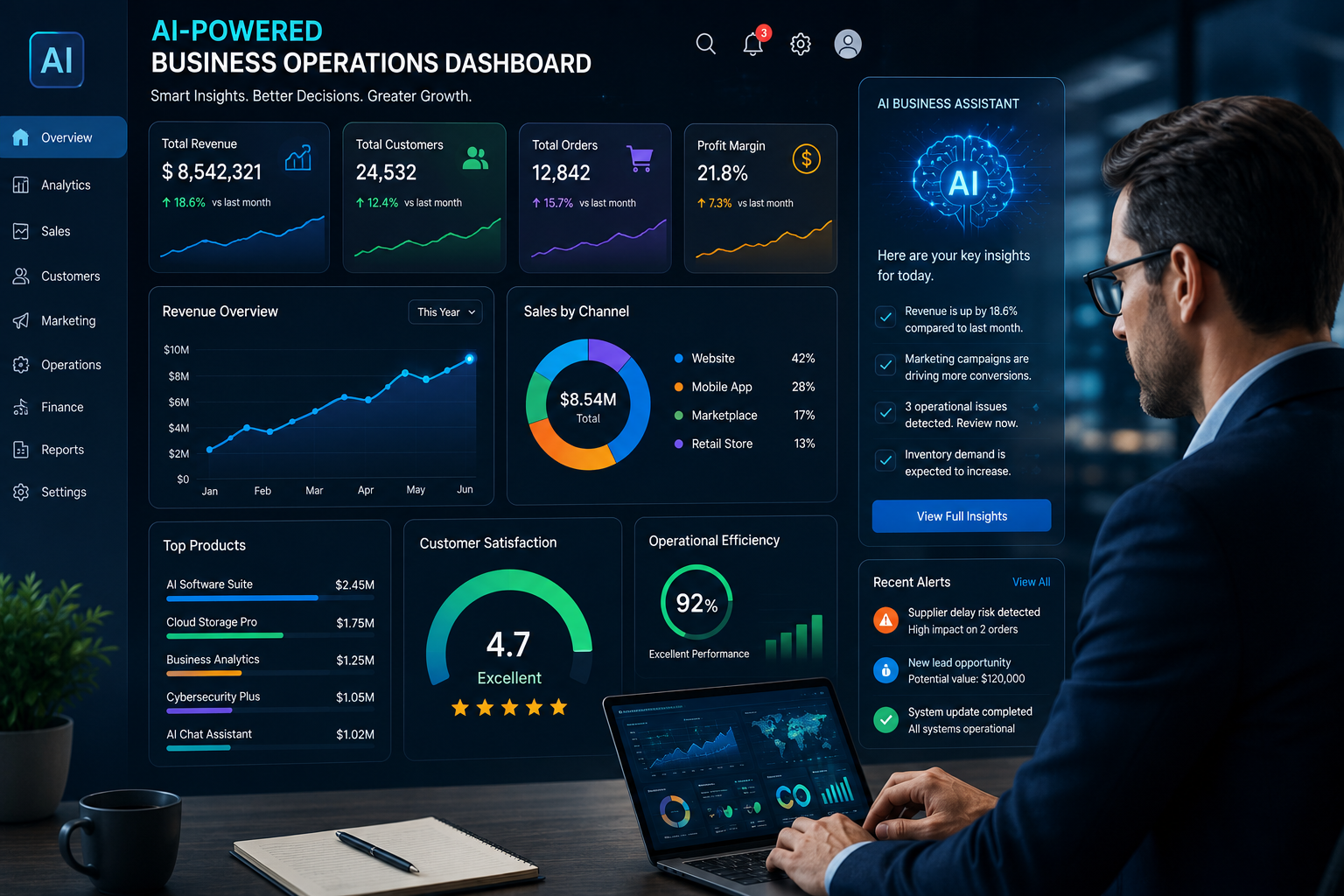
Executives rely on AI-powered dashboards to monitor business performance and receive real-time recommendations based on data.
This leads to smarter strategic planning and better business outcomes.
Benefits of AI for Businesses
Organizations implementing AI experience several advantages:
- Higher productivity
- Improved accuracy
- Faster decision-making
- Reduced costs
- Better customer experiences
- Enhanced innovation
- Competitive advantage
Challenges of AI Adoption
Despite its benefits, businesses should address several challenges:
- High implementation costs
- Data privacy concerns
- Integration with existing systems
- Employee training
- Ethical considerations
- Data quality issues
A well-planned AI strategy can help organizations overcome these challenges successfully.
Best AI Tools for Businesses
Popular AI platforms include:
- ChatGPT
- Microsoft Copilot
- Google Gemini
- Notion AI
- Salesforce Einstein
- HubSpot AI
- Grammarly
- Jasper AI
These tools support content creation, customer service, marketing, productivity, and business automation.
Future Trends in AI
The future of AI in business includes:
- Autonomous business processes
- AI-powered decision support
- Hyper-personalized customer experiences
- Intelligent supply chains
- Advanced robotics
- AI-driven cybersecurity
- Generative AI in every department
Businesses that embrace these trends will be better prepared for future growth and innovation.
Best Practices for AI Implementation
To maximize AI success:
- Start with clear business objectives.
- Invest in employee training.
- Ensure high-quality data.
- Choose scalable AI solutions.
- Measure ROI regularly.
- Continuously improve AI models.


