
Artificial Intelligence in Project Management: The Complete Guide for 2026
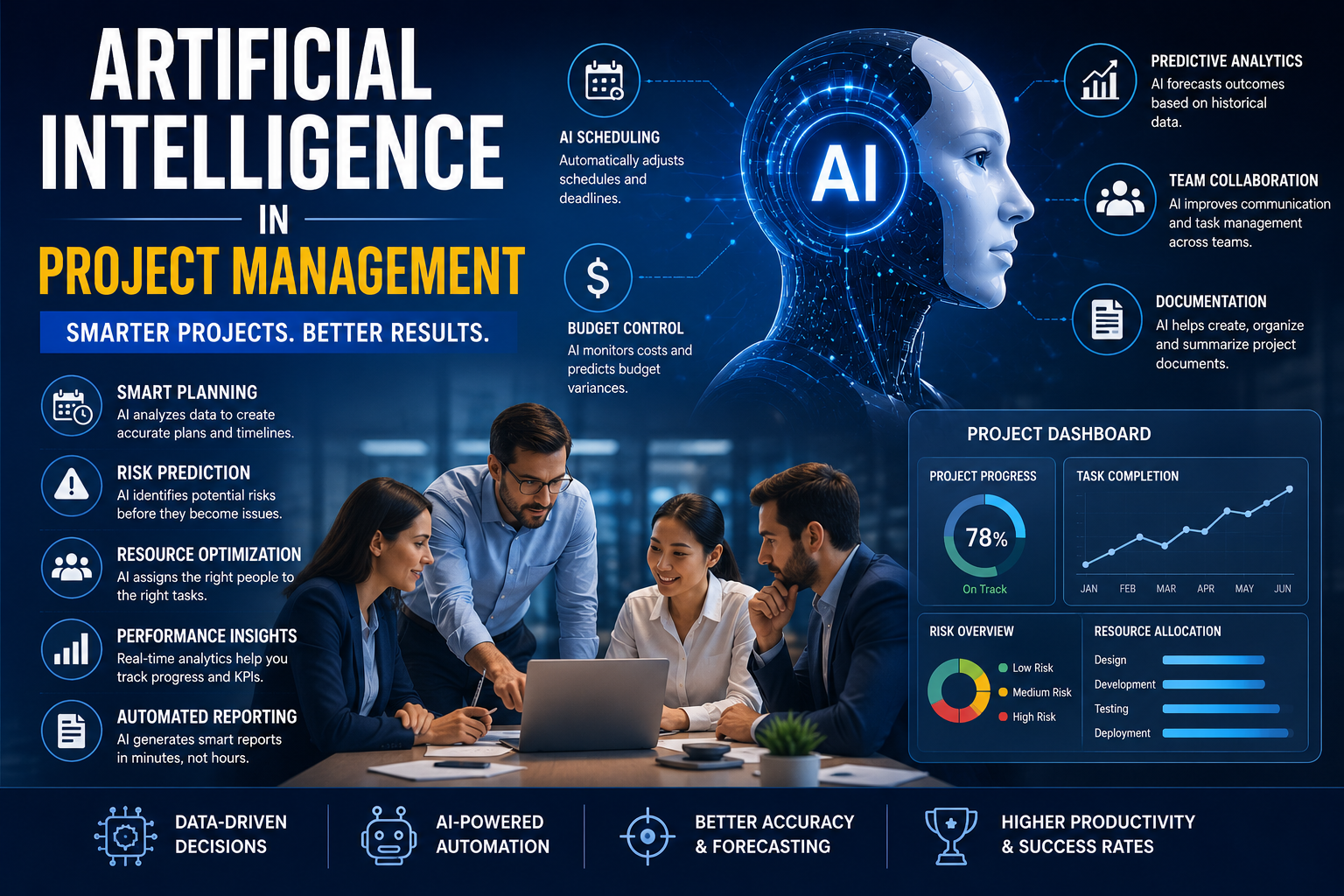
Artificial Intelligence (AI) is revolutionizing how organizations plan, execute, monitor, and deliver projects. From predictive analytics to automated scheduling and intelligent reporting, AI is enabling project managers to make faster decisions, reduce risks, and improve project success rates.
As businesses continue their digital transformation journey, Artificial Intelligence in Project Management has become a strategic advantage rather than a luxury. Organizations that integrate AI into their project management processes can improve productivity, reduce operational costs, and deliver projects more efficiently.
This comprehensive guide explores how AI is changing project management, the benefits it offers, the best AI tools available, and future trends that every project manager should know.
What is Artificial Intelligence in Project Management?
Artificial Intelligence in Project Management refers to the use of machine learning, predictive analytics, automation, and intelligent algorithms to improve project planning, execution, monitoring, and reporting.
Instead of spending hours creating schedules, analyzing risks, or preparing reports, AI-powered systems can perform these tasks in minutes while providing valuable insights based on historical project data.
AI supports project managers by:
- Automating repetitive administrative work
- Predicting project delays
- Identifying project risks
- Optimizing resource allocation
- Improving project forecasting
- Generating real-time reports
- Enhancing decision-making
Rather than replacing project managers, AI empowers them to focus on leadership, communication, stakeholder management, and strategic planning.
Why AI is Becoming Essential
Organizations manage increasingly complex projects involving multiple teams, tight budgets, and demanding deadlines.
Traditional project management methods often struggle to keep pace with changing business environments.
Artificial Intelligence solves these challenges by providing:
- Faster planning
- Better forecasting
- Accurate project insights
- Intelligent automation
- Improved collaboration
- Data-driven decisions
Businesses adopting AI are gaining a competitive advantage through higher efficiency and reduced project risks.
Key Benefits of Artificial Intelligence in Project Management
1. Intelligent Project Planning
AI analyzes historical projects to estimate timelines, budgets, resource requirements, and project complexity. This reduces planning errors and improves project accuracy.
2. Predictive Risk Management
Machine learning algorithms continuously monitor project performance and identify risks before they become critical issues.
Project managers can proactively implement mitigation strategies, reducing delays and cost overruns.
3. Automated Scheduling
AI automatically creates and updates project schedules based on resource availability, dependencies, and priority changes.
This minimizes manual scheduling efforts while keeping projects on track.
4. Smarter Resource Allocation
AI recommends the most suitable team members based on:
- Skills
- Experience
- Availability
- Workload
- Performance history
This improves productivity while preventing employee burnout.
5. Budget Forecasting
AI continuously tracks project expenditures and predicts future costs.
Organizations can detect budget overruns early and make informed financial decisions.
6. Automated Reporting
Project managers spend significant time preparing reports.
AI automatically generates:
- Progress reports
- Risk reports
- Budget summaries
- Performance dashboards
- Executive reports
This saves valuable time while improving reporting accuracy.
Best AI Tools for Project Managers
Several AI-powered platforms are transforming project management.
Popular solutions include:
- Microsoft Copilot
- ChatGPT
- ClickUp AI
- Asana Intelligence
- Monday AI
- Notion AI
- Jira AI
- Trello AI Extensions
These platforms assist with documentation, task prioritization, project planning, meeting summaries, workflow automation, and collaboration.
AI in Agile Project Management
Agile teams are increasingly adopting AI to improve sprint planning and project delivery.
AI helps Agile teams by:
- Prioritizing product backlogs
- Estimating user stories
- Monitoring sprint velocity
- Predicting delivery timelines
- Identifying sprint bottlenecks
The combination of Agile methodologies and Artificial Intelligence enables faster software development with improved quality.
AI in Software Development Projects
Software companies use AI throughout the Software Development Life Cycle (SDLC).
Applications include:
- Code generation
- Automated testing
- Bug detection
- Documentation
- Requirement analysis
- Sprint planning
- Performance monitoring
AI accelerates development while improving software quality.
Challenges of AI Adoption
Despite its advantages, organizations should consider several implementation challenges.
These include:
- Data privacy concerns
- Poor data quality
- Employee resistance
- Integration complexity
- Initial implementation costs
- Training requirements
A successful AI implementation requires effective governance, planning, and change management.
Future of Artificial Intelligence in Project Management
The future of project management will be increasingly AI-driven.
Emerging trends include:
- Autonomous project scheduling
- Intelligent PMO dashboards
- AI-powered virtual project assistants
- Predictive portfolio management
- Automated stakeholder communication
- Voice-controlled project management
Project managers who develop AI skills today will be better prepared for tomorrow’s workplace.
Best Practices for Implementing AI
Organizations should follow these best practices:
- Start with small pilot projects.
- Invest in employee training.
- Ensure high-quality project data.
- Select AI tools that integrate with existing systems.
- Monitor performance using KPIs.
- Continuously improve AI models.
These practices increase the likelihood of successful AI adoption.
Conclusion
Artificial Intelligence is reshaping project management by automating repetitive tasks, improving decision-making, predicting risks, and optimizing project performance.
Rather than replacing project managers, AI enables professionals to focus on leadership, innovation, collaboration, and delivering greater business value.
Organizations that embrace Artificial Intelligence today will be better positioned to deliver successful projects in the future.