
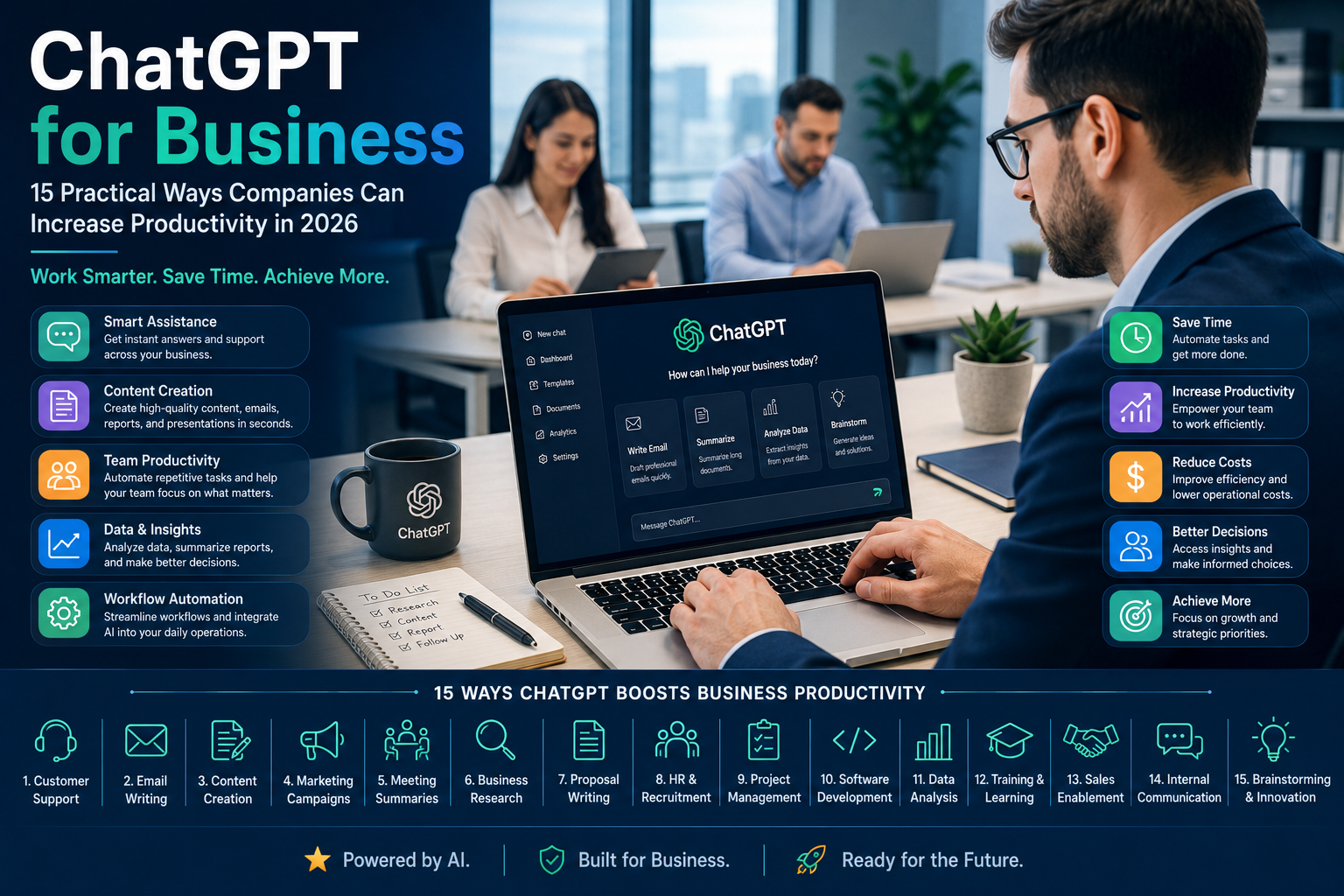
15 Practical Ways Companies Can Increase Productivity in 2026
Artificial Intelligence has rapidly transformed the modern workplace, and ChatGPT is leading this transformation. Businesses of all sizes are using AI to automate repetitive tasks, improve communication, streamline operations, and make faster, data-driven decisions.
Whether you’re running a startup, managing a growing company, or leading a large enterprise, ChatGPT can help your organization work smarter, reduce costs, and increase productivity.
In this guide, you’ll discover 15 practical ways businesses are using ChatGPT in 2026, along with implementation tips, benefits, and best practices.
What is ChatGPT?
ChatGPT is an AI-powered conversational assistant that understands natural language and generates human-like responses. It can help businesses write content, answer questions, summarize information, analyze data, generate code, draft emails, and much more.
Instead of replacing employees, ChatGPT acts as a productivity assistant, allowing teams to focus on strategic and creative work.
Why Businesses Are Adopting ChatGPT
Organizations are adopting ChatGPT because it helps them:
- Save time
- Reduce operational costs
- Improve customer satisfaction
- Increase employee productivity
- Enhance communication
- Automate repetitive work
- Support better decision-making
Businesses that effectively integrate AI into their workflows often complete routine tasks faster while maintaining quality.
15 Practical Ways Companies Use ChatGPT
1. Customer Support
ChatGPT can answer frequently asked questions, provide product information, and assist customers 24/7.
Benefits
- Faster response times
- Reduced support costs
- Improved customer satisfaction
- Consistent customer communication
2. Email Writing
Businesses use ChatGPT to write:
- Professional emails
- Follow-up messages
- Sales proposals
- Customer responses
- Internal announcements
This saves employees valuable time every day.
3. Content Creation
Marketing teams use ChatGPT to create:
- Blog articles
- Website content
- Social media posts
- Product descriptions
- Newsletters
- Press releases
Human review remains important to ensure accuracy, originality, and brand voice.
4. Marketing Campaigns
ChatGPT helps marketers:
- Brainstorm campaign ideas
- Write ad copy
- Generate landing page content
- Create email sequences
- Develop content calendars
This accelerates campaign planning and execution.
5. Meeting Summaries
Instead of manually documenting meetings, businesses can use ChatGPT to organize notes into:
- Action items
- Decisions
- Follow-up tasks
- Executive summaries
6. Business Research
ChatGPT helps teams quickly organize information and draft summaries based on their research, making it easier to compare options and prepare reports.
7. Proposal Writing
Sales and consulting teams use ChatGPT to prepare:
- Business proposals
- Project plans
- Scope documents
- Executive summaries
- Client presentations
This shortens proposal development time.
8. Human Resources
HR professionals use ChatGPT for:
- Job descriptions
- Interview questions
- Employee onboarding documents
- Company policies
- Training materials
9. Project Management
Project managers use ChatGPT to:
- Create project charters
- Develop work breakdown structures
- Draft meeting agendas
- Prepare risk registers
- Write status reports
This reduces administrative workload.
10. Software Development
Developers use ChatGPT to:
- Explain code
- Generate code examples
- Create documentation
- Troubleshoot programming issues
- Draft technical specifications
Developers should always review and test AI-generated code before deployment.
11. Data Analysis Support
ChatGPT can help explain datasets, suggest analytical approaches, and summarize findings provided by users.
Organizations should validate important business conclusions using trusted data sources and human expertise.
12. Training and Learning
Businesses create:
- Employee guides
- Learning materials
- SOPs
- Knowledge bases
- Internal documentation
using ChatGPT as a drafting assistant.
13. Sales Enablement
Sales teams use ChatGPT to:
- Prepare sales scripts
- Generate follow-up emails
- Create objection-handling guides
- Develop presentation outlines
14. Internal Communication
Companies draft:
- Company announcements
- Policy updates
- Team communications
- Weekly reports
- Department newsletters
using ChatGPT to improve clarity and consistency.
15. Brainstorming and Innovation
Teams use ChatGPT to generate ideas for:
- New products
- Business strategies
- Marketing campaigns
- Process improvements
- Customer engagement
AI serves as a creative partner during planning sessions.
Benefits of Using ChatGPT in Business
Organizations implementing ChatGPT often experience:
- Increased productivity
- Reduced administrative workload
- Faster document creation
- Better customer experiences
- Improved collaboration
- More consistent communication
- Cost savings through workflow efficiency
Best Practices for Using ChatGPT
To get the most value from ChatGPT:
- Define clear prompts.
- Review AI-generated content before publishing.
- Avoid sharing confidential or sensitive information unless using approved enterprise solutions.
- Train employees on responsible AI use.
- Combine AI assistance with human judgment.
Common Challenges
Businesses should also consider:
- AI can make mistakes or provide incomplete answers.
- Outputs should be fact-checked when accuracy is critical.
- Industry regulations may affect AI usage.
- Human oversight remains essential.
A balanced approach delivers the best results.
Future of ChatGPT in Business
As AI technology continues to evolve, businesses can expect:
- Smarter virtual assistants
- Better workflow automation
- AI-powered business intelligence
- Personalized customer experiences
- Improved collaboration tools
- More efficient business operations
Organizations that embrace AI responsibly will be well-positioned for future growth.
Frequently Asked Questions
Is ChatGPT suitable for small businesses?
Yes. ChatGPT can help small businesses save time by assisting with marketing, customer communication, documentation, and everyday administrative tasks.
Can ChatGPT replace employees?
No. ChatGPT is designed to support employees by automating routine work, allowing people to focus on higher-value tasks that require judgment, creativity, and relationship-building.
Is ChatGPT secure for business use?
Businesses should follow their organization’s security policies and avoid sharing confidential information with AI tools unless they are using approved enterprise solutions and understand the applicable privacy protections.
Which departments can benefit from ChatGPT?
Marketing, sales, customer support, HR, finance, project management, IT, operations, and executive leadership can all benefit from appropriate use of ChatGPT.
Conclusion
ChatGPT is transforming the way businesses work by helping teams automate repetitive tasks, improve communication, create high-quality content, and streamline operations.
When used responsibly alongside human expertise, ChatGPT can become a valuable productivity assistant that supports innovation and business growth. Organizations that invest in AI literacy and thoughtful implementation today will be better prepared to compete in the digital economy of tomorrow.